 The lowest listed starting price does not identify the right waterfront solution by itself. This article compares gabion retaining walls, and reinforced concrete retaining walls through natural drainage and flexibility versus rigid load resistance and engineered reinforcement. The purpose is to show what changes when the site, load, water behavior, foundation, material, and intended use are held constant. That approach avoids a misleading best-option ranking and keeps the analysis connected to an actual waterfront project.
The service page provides the confirmed project scope and material categories used for this comparison. Property owners can compare the available wall options here before using the sections below to organize questions for a site review and estimate.
A fair side-by-side review of gabion retaining walls, and reinforced concrete retaining walls uses the same questions for every option: what force must be controlled, what supports the structure, how the water level behaves, what access is available, and how the property will be used. For this article, the decisive frame is natural drainage and flexibility versus rigid load resistance and engineered reinforcement. An option that performs well under one set of conditions can be an unsuitable comparison under another because the structures are not being asked to do the same work.
Function comes before material
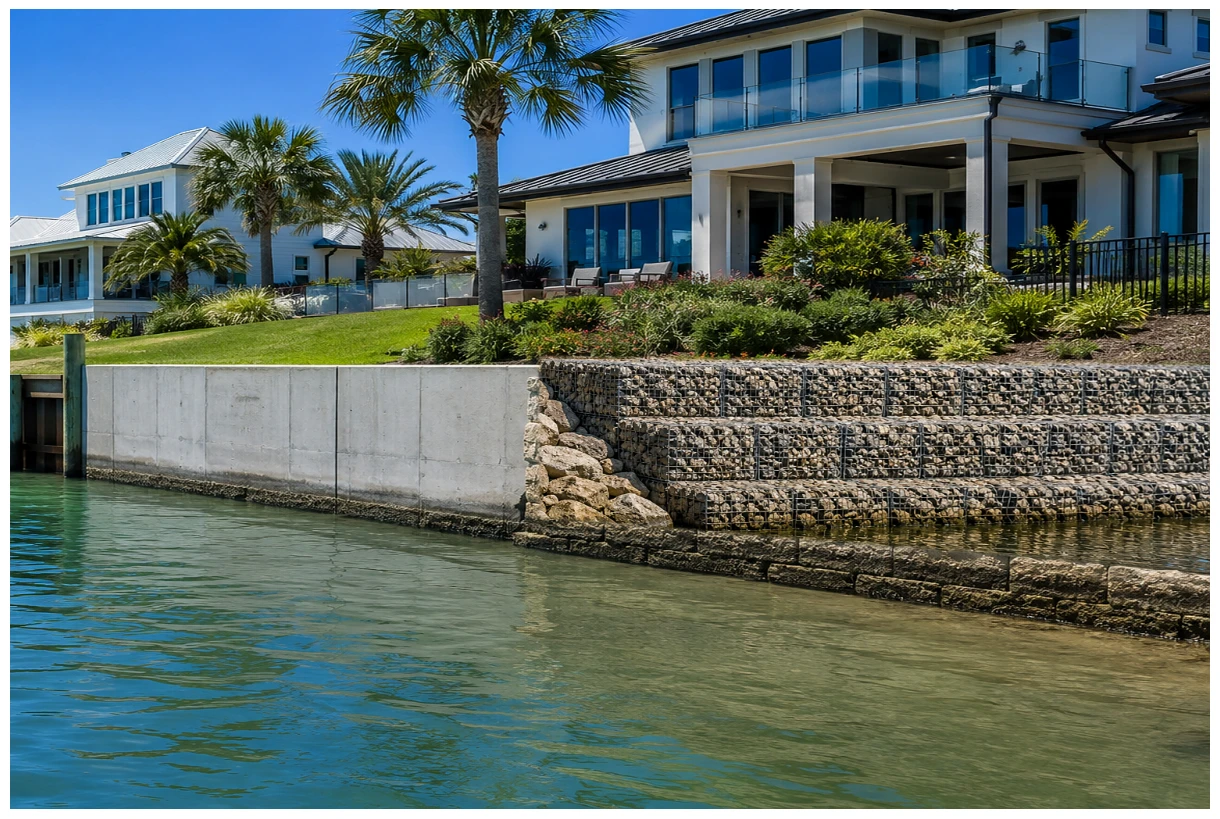
The practical case for gabion retaining walls comes from their function, support system, and relationship to the water and ground. Wire baskets with rock fill listed from $200 per linear foot. Provide strong drainage and a natural-looking face for slopes and hillsides. Have a more flexible form than a monolithic rigid wall. Depend on basket support, rock fill, connections, and stable foundation conditions. In Gabion vs Reinforced Concrete Retaining Walls: Drainage, Load, and Durability, this option is assessed through natural drainage and flexibility versus rigid load resistance and engineered reinforcement.
When reinforced concrete retaining walls are evaluated, the visible material is only one part of the decision. Rigid engineered walls used where load and wall geometry require reinforced structural capacity. Planned around soil pressure, groundwater, foundations, reinforcement, and drainage. Can support demanding private or commercial slope-retention applications. Require site-specific calculations rather than selection by appearance alone. In Gabion vs Reinforced Concrete Retaining Walls: Drainage, Load, and Durability, this option is assessed through natural drainage and flexibility versus rigid load resistance and engineered reinforcement.
Several page facts help keep the analysis practical. Retaining walls hold soil on properties with elevation changes, stabilize slopes, create terraces, and help protect foundations from soil movement. Material selection depends on wall height, soil type, groundwater level, loading, drainage, and appearance goals. Walls over four feet are described as requiring anchor systems and reinforcement. In Gabion vs Reinforced Concrete Retaining Walls: Drainage, Load, and Durability, these points are used specifically to compare gabion retaining walls, and reinforced concrete retaining walls through natural drainage and flexibility versus rigid load resistance and engineered reinforcement.
The conditions that separate one option from another
Exposure, ground, and access conditions provide a stricter test for gabion retaining walls and reinforced concrete retaining walls. Provide strong drainage and a natural-looking face for slopes and hillsides. Planned around soil pressure, groundwater, foundations, reinforcement, and drainage. The difference does not make one option better in every setting; it shows that the same property goal must be translated into the correct response to water, soil, bottom, slope, or access. Material selection depends on wall height, soil type, groundwater level, loading, drainage, and appearance goals. This site-level review is applied here to natural drainage and flexibility versus rigid load resistance and engineered reinforcement.
- Soil and foundation – Identify soft soil, sand, clay, silt, rock, groundwater, and the likely foundation approach. The visible structure depends on piles, bases, anchors, reinforcement, or support frames below and behind it. For Gabion vs Reinforced Concrete Retaining Walls: Drainage, Load, and Durability, use this checkpoint to compare gabion retaining walls, and reinforced concrete retaining walls through natural drainage and flexibility versus rigid load resistance and engineered reinforcement.
- Water-level behavior – Note whether the water level is comparatively stable or moves seasonally or tidally. Fixed and floating access systems respond differently, and shoreline walls may face changing pressure or erosion patterns. For Gabion vs Reinforced Concrete Retaining Walls: Drainage, Load, and Durability, use this checkpoint to compare gabion retaining walls, and reinforced concrete retaining walls through natural drainage and flexibility versus rigid load resistance and engineered reinforcement.
- Structural load – List the people, boats, equipment, soil, wave, or traffic loads the project must carry. A private residential use and a marina or commercial setting should not be compared as though they demand the same structure. For Gabion vs Reinforced Concrete Retaining Walls: Drainage, Load, and Durability, use this checkpoint to compare gabion retaining walls, and reinforced concrete retaining walls through natural drainage and flexibility versus rigid load resistance and engineered reinforcement.
- Material objective – State whether the priority is a lower listed starting cost, natural appearance, reduced routine upkeep, corrosion resistance, flexibility, drainage, or maximum structural strength. No single material leads every category. For Gabion vs Reinforced Concrete Retaining Walls: Drainage, Load, and Durability, use this checkpoint to compare gabion retaining walls, and reinforced concrete retaining walls through natural drainage and flexibility versus rigid load resistance and engineered reinforcement.
- Maintenance plan – Decide what inspection and upkeep the owner is prepared to perform. Low-maintenance surfaces do not eliminate the need to inspect foundations, connections, anchors, drainage, piles, or framing. For Gabion vs Reinforced Concrete Retaining Walls: Drainage, Load, and Durability, use this checkpoint to compare gabion retaining walls, and reinforced concrete retaining walls through natural drainage and flexibility versus rigid load resistance and engineered reinforcement.
- Repairability – Separate isolated defects from system-wide failure. Repair can preserve serviceable components, while replacement becomes a different scope when supports, alignment, drainage, or overall capacity are no longer reliable. For Gabion vs Reinforced Concrete Retaining Walls: Drainage, Load, and Durability, use this checkpoint to compare gabion retaining walls, and reinforced concrete retaining walls through natural drainage and flexibility versus rigid load resistance and engineered reinforcement.
Structure, support, and installation
The visible material should be evaluated together with the structure behind or beneath it. For gabion retaining walls, have a more flexible form than a monolithic rigid wall. For reinforced concrete retaining walls, can support demanding private or commercial slope-retention applications. Foundations, piles, anchors, frames, reinforcement, drainage, and connections are not optional details; they are the parts that transfer load and keep the selected material in the position where it can work. A proposal that names only the surface material is therefore incomplete.
The intended use of the property changes the comparison. Private access, frequent public traffic, a small boat, a large vessel, commercial equipment, or a high retained slope impose different loads and dimensions. Gabion Retaining Walls and reinforced concrete retaining walls should therefore be compared against the same use case. The service pages distinguish residential work from marinas and other commercial projects, which is a reminder that size and load cannot be separated from material and foundation choices.
Understanding starting prices and total scope
Cost comparison should use the same scope and the same site assumptions. The official page provides starting figures or service categories, but those references do not replace a project estimate. Length or area, material, foundations, removal, repair, access, water depth, soil or bottom conditions, drainage, anchors, piles, and accessories can change the amount of work. The useful question is not simply whether gabion retaining walls appear cheaper than reinforced concrete retaining walls; it is whether both proposals include everything required to perform the same job at the same property.
Maintenance has to be divided into surface care and structural inspection. A material described as low-maintenance can reduce routine work on the visible surface, but the owner still needs to watch the support system, connections, drainage, anchors, piles, frames, settlement, and shoreline transitions. Depend on basket support, rock fill, connections, and stable foundation conditions. Require site-specific calculations rather than selection by appearance alone. The correct comparison considers what can be inspected and repaired over time, not only what looks finished on completion day.
The available service data shows why a universal answer would be misleading. The page lists treated lumber, natural stone, gabions, concrete blocks, concrete bags, and reinforced concrete approaches. Wood retaining walls start at $150 per linear foot, stone at $180, gabions at $200, concrete blocks at $180, concrete bags at $120, and repair at $70, with labor and materials included in the listed starting figures. Proper load calculation, drainage, foundation preparation, and site analysis are presented as essential parts of retaining wall work. In Gabion vs Reinforced Concrete Retaining Walls: Drainage, Load, and Durability, these points are used specifically to compare gabion retaining walls, and reinforced concrete retaining walls through natural drainage and flexibility versus rigid load resistance and engineered reinforcement.
Decision checkpoints for property owners
- Measure the route or shoreline – Create an approximate length, area, or access route so material quantities and work zones can be discussed consistently. Apply it here to gabion retaining walls, and reinforced concrete retaining walls, with emphasis on natural drainage and flexibility versus rigid load resistance and engineered reinforcement.
- Photograph the entire area – Include the full structure, shoreline transitions, waterline, nearby buildings, access, and close views of damage or ground conditions. Apply it here to gabion retaining walls, and reinforced concrete retaining walls, with emphasis on natural drainage and flexibility versus rigid load resistance and engineered reinforcement.
- List current defects or access needs – Record leaning, settlement, cracks, lost backfill, damaged boards, pile movement, poor drainage, difficult boat access, or unstable walking areas without assuming the cause. Apply it here to gabion retaining walls, and reinforced concrete retaining walls, with emphasis on natural drainage and flexibility versus rigid load resistance and engineered reinforcement.
- Compare options by the same criteria – Use function, exposure, foundation, load, maintenance, access, and future use for every alternative rather than changing the standard from one option to another. Apply it here to gabion retaining walls, and reinforced concrete retaining walls, with emphasis on natural drainage and flexibility versus rigid load resistance and engineered reinforcement.
- Confirm the final construction scope – Make sure the selected proposal states what will be built, repaired, reinforced, removed, or retained and how the work connects to the existing property. Apply it here to gabion retaining walls, and reinforced concrete retaining walls, with emphasis on natural drainage and flexibility versus rigid load resistance and engineered reinforcement.
When gabion retaining walls and reinforced concrete retaining walls are placed on the same property, the site becomes the deciding evidence. Provide strong drainage and a natural-looking face for slopes and hillsides. Planned around soil pressure, groundwater, foundations, reinforcement, and drainage. The difference does not make one option better in every setting; it shows that the same property goal must be translated into the correct response to water, soil, bottom, slope, or access. Material selection depends on wall height, soil type, groundwater level, loading, drainage, and appearance goals. This site-level review is applied here to natural drainage and flexibility versus rigid load resistance and engineered reinforcement.
A site-specific answer is the useful answer
A final choice between gabion retaining walls, and reinforced concrete retaining walls should follow the confirmed site conditions. The official service information provides the available categories, but the property determines the foundation, structural details, material, and scope. A proposal is strongest when it explains why the selected option fits the shoreline and what conditions were used in that decision.
For Gabion vs Reinforced Concrete Retaining Walls: Drainage, Load, and Durability, the next practical step is to provide the property location, photographs, approximate dimensions, and a description of the required result. Those details support a preliminary review focused on natural drainage and flexibility versus rigid load resistance and engineered reinforcement and help identify what must be verified during the site assessment before construction, repair, or replacement is defined.